

Originally published in WARC on 30 October 2026 and republished here with WARC's permission. The original sits behind WARC's subscriber wall, so we are sharing the full text below for readers without access.
Why it is on our site: this article sets out the idea Animo was built on. Ratings and reach describe what a campaign delivered, while the decision that matters is which spots, dayparts and creative earned their budget, and whether you found out early enough to change them.
How high-resolution measurement can help advertisers challenge conventional buying decisions and optimise TV and radio while campaigns are still running.
Why it matters
Reliable outcome measurement can open the door to performance-linked trading models alongside exposure-based buying.
Key takeaways
- Plan media around business outcomes, not reach or ratings, and challenge habitual buying patterns regularly.
- Optimise below channel level – by spot, daypart, creative – and keep flexibility to reallocate budget mid-campaign.
- Replace periodic MMM reports with continuous measurement loops, enabling faster, evidence-based media decisions.
Start with business outcomes, not ratings
Imagine a marketing director reporting that a campaign delivered its planned reach, secured competitive ratings and ran exactly as booked. The CEO then asks a simpler question: what did it do for the business? Did it create incremental demand, drive brand searches, generate enquiries or increase sales? More importantly, what did we learn early enough to change?
Reach, frequency and GRPs remain essential planning and trading measures. But they are not substitutes for business outcomes. Once media delivery is connected to customer responses, the relevant decision becomes which channels, programmes, dayparts, placements, formats and creative executions generate the greatest business value for the money invested.
The essential question is not only what worked, but whether we learned it in time to act.
1. Break the buying habit: Plan around the advertiser’s objectives
Research by Dr Oren Dayan examined television advertising in Israel across at least three brands in each of five advertiser categories over six consecutive months. It found striking similarities in the allocation of spots across six dayparts, with a reported average standard deviation of 5.2% across category mixes.1
An insurer, automotive brand, credit provider and snack manufacturer can have very different audiences, conversion journeys and commercial goals. Why, then, might their television schedules look so similar? Some overlap may be explained by viewing patterns, inventory availability and prices. But the findings raise an important question about how far established trading practices shape the plan.
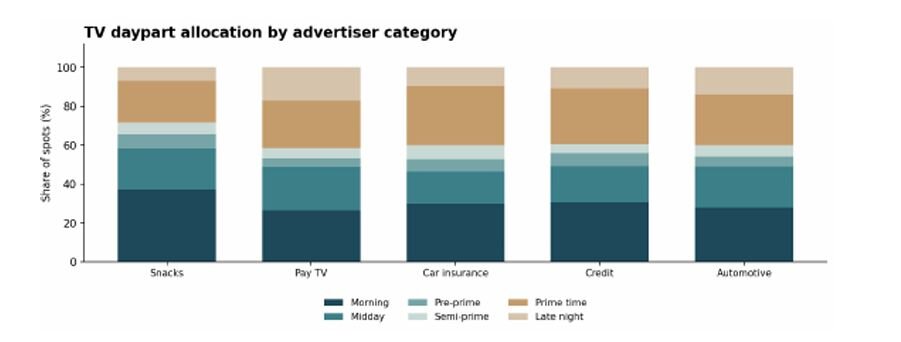
The research does not prove that those schedules were wrong or that commercial incentives caused the similarities. It does, however, challenge advertisers and their agencies to demonstrate that alternatives were tested against each brand’s business goals, rather than adopted because they were familiar or convenient.
Acknowledge commercial incentives – and improve the decision process
Media buying operates through annual commitments, volume discounts, trading agreements and commissions. These can deliver genuine advantages. Yet the best price for exposure is not necessarily the best cost per business outcome.
In one discussion, I shared evidence that a sports channel was delivering an attractive cost per conversion and suggested shifting some investment towards it. The agency executive explained that the agency did not receive commission from that channel. This is an individual anecdote, not evidence about every agency; it illustrates how a legitimate commercial structure can sometimes pull against the advertiser’s objective.
The answer is not to attack agencies or abolish trading agreements. It is to make the commercial trade-offs visible, compare realistic alternatives using business outcomes and preserve the ability to shift investment when the evidence supports a different plan.
2. Optimise below channel level – right down to the spot
Television and radio advertising effectiveness can be assessed at much finer granularity than a channel or station average. With sufficiently reliable transmission and response data, media attribution can support comparisons by programme, daypart, spot position within an advertising break, creative execution, spot length and format, including standard spots versus sponsorships.
Four comparisons using cost per enquiry
In one television campaign, the measured cost per enquiry was NIS 138 for a spot in the second position of a commercial break, versus NIS 498 for a spot in the seventh position – a 3.6x difference, or approximately 261% higher cost in the latter position. The comparison does not, on its own, establish that position caused the difference; channel, schedule, creative, media prices and sample size must also be considered.
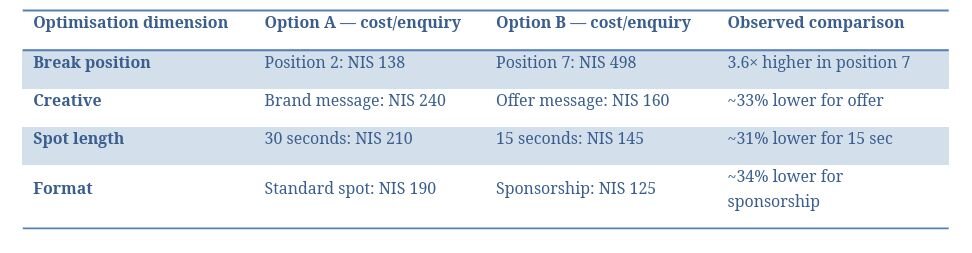
These examples are not claims that short spots always outperform long ones, sponsorship always beats a commercial, or offer-led creative always produces better value than brand-led creative. Their purpose is to show that decisions previously made largely around reach, inventory and price can also be assessed using a common business KPI, with controls for comparability and attention to lead quality and brand effects.
The same approach can be applied to brand searches, website visits, phone calls, qualified leads, store visits or sales, depending on the advertiser’s objective. This is media mix optimisation at the level where buying and creative decisions actually occur.
3. Buy flexible media and optimise in-flight
A 30-day campaign should not remain unchanged for 30 days simply because the original booking said so. Suppose cost per enquiry is attractive in week one, but begins rising on day eight while customer response weakens – even though reach and delivery continue to meet plan. Day eight is an illustrative scenario, not a claim about a specific client.
Instead of waiting for an end-of-campaign report, the advertiser can investigate the cause in-flight. Is a creative execution wearing out? Are certain dayparts losing efficiency? Could a shorter spot or sponsorship achieve more for the same budget? Is the best response concentrated in a different station or programme? Depending on the evidence, investment can be moved, creative rotated, schedules changed or unproductive activity curtailed.
The critical requirement is not only measurement technology. It is commercial flexibility. Upfront packages and volume commitments can be economical, but locking every pound into a fixed plan can render timely insights unactionable. A results-driven plan should preserve practical options to reallocate spend while the campaign is live.
4. Move from periodic MMM reports to continuous decisions
Marketing Mix Modelling (MMM) is valuable for estimating how media investment contributes to business results while accounting for other drivers. But a study refreshed every few months cannot, on its own, answer every question facing a manager who needs to adjust live activity. Connecting offline and digital data, statistical models and AI-enabled analysis creates the potential for faster, recurring decisions.
Cross-channel measurement also changes how marketers understand the customer journey. Someone might see a TV ad, hear a radio spot, search for the brand and ultimately complete an enquiry online. Last-click attribution may credit the final touchpoint while obscuring the media that helped create the initial demand. MMM and causal measurement can estimate aggregate contributions without claiming to reconstruct every individual journey.
Incrementality measurement remains central: an observed response after an ad is not automatically a response caused by that ad. Models should be calibrated where practical using experiments, comparison groups and other causal evidence. The objective is not merely a report available at the click of a button, but an ongoing loop of measurement, recommendation, implementation and validation.

Traditional MMM retains value for long-term planning and strategic budget allocation. What changes is the expectation that these insights should be integrated with more frequent operational data and AI-powered media optimisation, enabling advertisers to act and assess whether the action worked.
5. Turn measurement into strategic change: two advertiser cases
a) Investment services: from bursts to a more continuous presence
A major Israeli investment and financial services advertiser previously concentrated much of its television activity into two or three bursts per year, often in high-rating slots. Analyses of upper-funnel responses – particularly brand search and website traffic – prompted a shift towards more continuous activity through the year, with a broadly comparable media budget.
A December 2024 Ifat advertising recall survey reported 31% recall in the investment category and 18% in insurance; the marketing director also reported improvements in internal brand-tracking results.2 The surveys do not, by themselves, prove the scheduling change caused those results. The lesson is that response measurement can reshape the media calendar, not simply adjust the price of individual spots.
b) Vehicle leasing, sales and rental: efficiency before scale
A leading Israeli vehicle leasing, sales and rental company analysed historical media delivery alongside business responses and adjusted allocation towards more effective investments. According to its case data, cost per enquiry improved by approximately 60% across the measured activity, while cost per television conversion improved by approximately 50%.3
The company subsequently expanded its investment, and the overall programme was accompanied by roughly 600% growth in the number of enquiries. That entire growth should not be attributed to optimisation: increased spend was also a major contributor. The point is that optimisation is not always about spending less. It can reveal where increasing investment makes business sense.
Incremental impact can begin in month one
According to ANIMO’s reported results, across the measured activities in which its optimisation recommendations were implemented, incremental business outcomes increased by at least 30% from the first month of implementation.4 Here, incremental lift means additional outcomes above the estimated baseline that would have been expected without the change – not simply a 30% increase in gross responses or a 30% reduction in media costs.
The comparison uses the defined business outcome, estimated counterfactual baseline and first-month evaluation period. These are ANIMO-reported results from measured activities in which its recommendations were implemented.
6. The blue ocean may be in media we already know
Digital channels have long enjoyed a measurement advantage, especially when reporting focuses on clicks and final conversions. Yet ease of attribution is not the same as true business contribution. TV and radio can create demand before a consumer searches or converts online; without cross-channel measurement, those earlier contributions may be overlooked.
A smaller television channel, an unfashionable radio station, a less sought-after daypart or an underused ad format may turn out to deliver efficient incremental business results. The “blue ocean” need not be a new platform: it can be inventory that already exists but has not been evaluated against the right outcome.
That also creates an opportunity to reconsider spend that migrated to digital partly because digital was easier to measure. The evidence should determine whether money moves back – not an assumption that offline is always better. Both online and offline media can create and capture demand, and both belong in the same decision framework.
Ultimately, reliable outcome measurement can open the door to performance-linked trading models alongside exposure-based buying. Such models require agreed definitions, quality controls and robust evaluation of incremental impact, but they can help align incentives between advertisers, agencies and media owners.
Three decisions for the next media planning meeting
- Ask to see how the plan was derived from a defined business outcome, including the channels, dayparts, creative versions, spot lengths and formats that contributed to it – and at what cost.
- Keep real contractual and operational flexibility to redirect spending during the campaign, rather than merely diagnose missed opportunities afterwards.
- Establish a repeating cycle of measurement, recommendations, implementation and verification across television, radio and digital media.
Success means improving the plan – not just delivering it
A marketing director should not have to defend success solely in terms of ratings, reach or advantageous trading. The more relevant account is what was learned, where investment was increased or reduced, which creative execution changed, and what happened to the underlying business KPI.
Media planning must be driven by business outcomes, not trading habits. Better measurement does not invalidate the experience of media agencies or the economics of aggregated buying. It gives advertisers, agencies and media owners a stronger basis for deciding where to invest, when to change course and how to evaluate the results.
Sources and disclosure
- Dr Oren Dayan, “Fixing the Fixation” – observational study of television media-planning patterns in Israel, covering at least three brands in each of five advertiser categories over six consecutive months, comparing spot allocation across six dayparts (research materials supplied by the author).
- Investment-services advertiser: campaign analysis and Ifat advertising recall survey (December 2024).
- Vehicle leasing, sales and rental advertiser: campaign analysis of enquiry costs, television conversions and enquiry volume.
- ANIMO campaign analyses: break position, creative execution, spot length, advertising format and first-month incremental business outcomes.
Disclosure: The author is co-founder and CEO of ANIMO, a marketing measurement and media optimisation technology provider. The advertiser cases and comparisons cited here are based on analyses conducted using ANIMO. Advertiser identities have been withheld.